
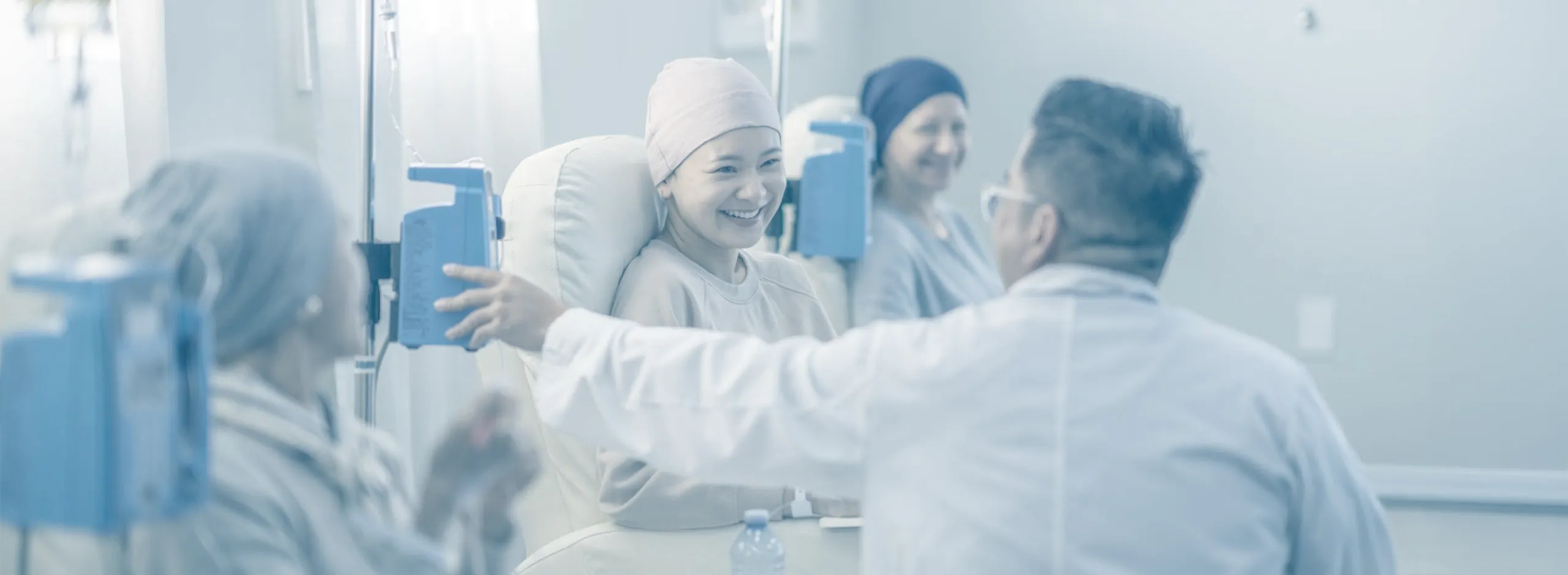
Oncology and nutritional monitoring with bioimpedance
The impact of cancer on public health
According to Santé Publique France, in 2022, cancer represented the leading cause of mortality in France, accounting for 25.5% of deaths, despite a clear improvement in therapeutic care over the last decades. In addition to antitumor therapy, patient care includes nutritional and physical activity approaches aimed at maintaining the quality of life and well-being of patients, while also preventing the loss of skeletal muscle mass associated with cancer.
Devices designed by Aminogram offer a fast, simple, non-invasive, and precise method to evaluate health risks and measure the impact of interventions based on body composition data. In less than 10 seconds, the analysis allows for monitoring changes in body composition, particularly skeletal muscle mass, in order to optimize care and improve patients’ quality of life.
With devices designed by Aminogram, offer personalized and precise monitoring for better care of cancer patients.
Testimonial: Dr. Alain Toledano, Institut Rafaël
Oncologist and founder of the Institut Rafaël, Dr. Alain Toledano explains why monitoring cancer patients can no longer stop at weight, and how bioimpedance measures what really matters: muscle mass.
“Muscle is an organ of well-being, it's an anti‑cancer organ.”
- 115caregivers from 45 disciplines at the Institut Rafaël
- 170,000care sessions for 6,600 patients in eight years
- −60%in depression rates, without medication
Read the video transcript
Hello, my name is Alain Toledano, I am an oncologist and the founder of the Institut Rafaël. What is the Institut Rafaël? At the Institut Rafaël, we bring together doctors and non-medical practitioners: nutritionists, psychologists, sophrologists and art therapists. There are 115 caregivers from 45 disciplines working hand in hand.
And together we co-construct with all our patients support pathways that are coordinated and oriented towards nutrition, emotional management, physical activity, well-being and returning to work. We offer all this care to all patients and we evaluate it to show that by taking care of someone globally, it is much better than if we only took care of their illness.
In eight years of practice, we have provided 170,000 care sessions to 6,600 patients, showing that this comprehensive care allowed for a 60% reduction in depression rates without medication, for example, the feeling of isolation just as much, digestive issues, sleep disorders and just about all symptoms.
Today, it is fundamental to move from a medicine centered on the disease to a medicine centered on the individual and their life project. That is why we must offer all patients with cancer, but generally those with chronic illnesses —which still corresponds to 25 million French people— support pathways. We can no longer be satisfied with just drug therapies and disease management. We must integrate these complementary approaches, break down silos and work as a team.
So, at the Institut Rafaël, for each patient today, as part of an initial assessment and during re-evaluations, we don't just ask the question: “What is their weight?” We ask the question of bioelectrical impedance, the ratio between fat mass and lean mass, the amount of muscle, the proportion of muscle.
First of all, for an oncologist, it's very important, because the more muscle you have, the better treatments are tolerated and the fewer side effects you have. And conversely, muscle wasting, sarcopenia, worsens the toxicity of treatments and makes them less effective. There are patients who are obese with sarcopenia, with muscle wasting. And so, one can be fooled by weight or body image. That's why we must go well beyond just weight. We must look at this bioimpedance and this proportion of muscle. Muscle is an organ of well-being, it's an anti-cancer organ, it's an organ that will reduce cardiovascular diseases and chronic illnesses.
So, today we have a possibility, easily accessible to everyone, to implement these bioimpedance measurements in clinical practice in just a few seconds. This allows us to monitor. Now, it's true that people like numbers, but above all, we have a metric for the goals to be achieved. And the discussion, the motivation and the support are based on a real, scientifically proven evaluation that allows us to improve support pathways and, above all, to monitor them and evaluate their effectiveness. Because value in healthcare must be evaluated so that one day, all patients, all patients can have access to the best support pathway.
We know that today, when we prescribe hormone therapy to a woman who has had breast cancer, for example, 40% will not take it, they are not compliant with the treatment. For many patients, it's because they are afraid of having joint pain, which isn't always the case, by the way, but it's the fear of gaining weight and the body image, which may already be distorted by breast cancer treatments.
So, it's true that we had, for example, this patient who was 47 years old and who was hesitant to take her hormone therapy. So, we started supporting her. We ultimately showed that she had a bit more fat mass than muscle mass. And in a few weeks, we started a support program with nutrition and physical activity. She developed a taste for exercise. There were even interpersonal resources: she spent time with other patients who were going through the same thing as her. And then she started to get motivated. She came to ask us to take her treatment and her hormone therapy.
In three months, we saw a metabolic change, a change in body image, an improvement in self-esteem, muscle gain and very good medication compliance. And it's true that the tool made it possible to objectify these efforts. Ultimately, the perceived benefit was objectified in numbers. And then for us, it's important because we were finally able to demonstrate the benefits of this support.
Today, we cannot just be content with doing either sports, nutritional care or psycho-emotional care. It is important to work on all dimensions of health, to integrate psychological, emotional, sexual and social health. It is important that caregivers work together, hand in hand. So, we often say multidisciplinary, but we must say transdisciplinary, because there is a real synergy. When sports, nutrition and psycho-emotional disciplines work together, it leads to real turning points in life, improvements in life paths. It allows for moving towards healing.