
Key points
- The clinical/preclinical distinction proposed by the 2025 Lancet Diabetes & Endocrinology Commission brings obesity assessment in line with that of other chronic diseases, shifting the diagnostic focus from body-size thresholds to organ dysfunction.
- In a validation study involving 844,108 adults from four countries, clinical obesity was associated with higher all-cause mortality than preclinical obesity. Anthropometric confirmation helped correct BMI misclassification in both directions, while most individuals with preclinical obesity remained stable over a decade.
- Before organ function is assessed, excess adiposity must be confirmed. The Commission accepts direct fat measurement, such as DXA or bioimpedance, but sets no fat mass percentage (FM%) threshold to interpret it.
- In routine practice, confirmation still relies mostly on waist-based anthropometry, which improves on BMI but still misclassifies a substantial proportion of individuals compared with dual-energy X-ray absorptiometry (DXA).
- The ESPEN/EASO consensus on sarcopenic obesity already defines obesity as an increased FM%, accepts bioelectrical impedance analysis (BIA) as a second choice after DXA, and proposes the reference values of Gallagher et al.
- A reliable BIA-estimated FM% requires equations validated for the device and the population, standardised measurement and appropriate reference values.
- Whether BIA-estimated FM% improves the classification and prognosis of clinical and preclinical obesity compared with anthropometry remains to be shown in prospective studies.
A much-needed diagnostic framework
BMI reflects body size, not health status: it does not distinguish fat from fat-free mass, ignores fat distribution and says nothing about organ function. At the same BMI, one person may be healthy and another may have heart failure or disabling osteoarthritis. Treating obesity only as a risk factor can delay care for those already ill, while treating all obesity as a disease risks overdiagnosis and overtreatment 1.
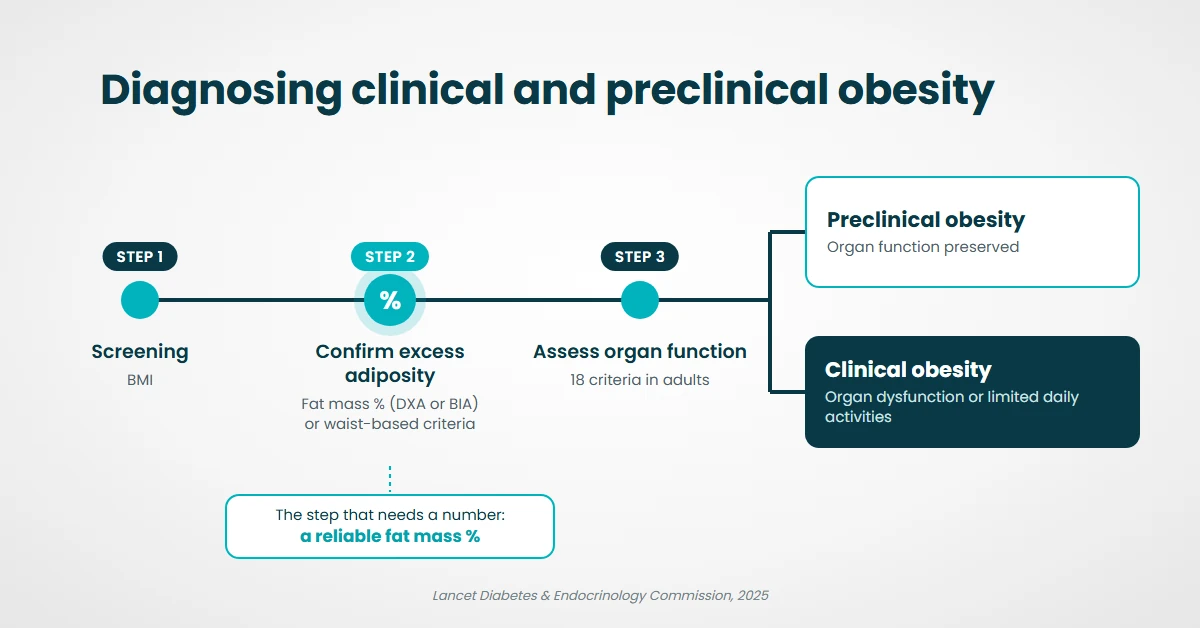
In 2025, the Lancet Diabetes & Endocrinology Commission, made up of 58 experts and endorsed by more than 75 organisations, defined obesity as excess adiposity and proposed two categories. Preclinical obesity means organ function is preserved. Clinical obesity means excess adiposity directly causes organ dysfunction or significantly limits activities of daily living 1.
The diagnosis follows three steps: screening with BMI; confirming excess adiposity by direct fat measurement (e.g. DXA or bioimpedance), by BMI plus one waist-based criterion (waist circumference, waist-to-hip ratio or waist-to-height ratio), or by two of these criteria; and assessing organ function against 18 adult criteria (13 in children). Above a BMI of 40 kg/m², excess adiposity can be assumed. When BMI is near but below the obesity cut-off (30 kg/m², or 27.5 kg/m² in Asian populations), direct fat measurement or two waist-based criteria can confirm obesity regardless of BMI 1.
The second step is decisive: a person wrongly labelled as having excess adiposity may be treated needlessly, while one whose excess fat is missed never reaches the organ assessment. Throughout, the target of care moves from weight to organ function, and weight loss becomes a means rather than an end.
What do the first validation data show?
Pan et al. tested the framework in 844,108 adults from four cohorts in China, the UK, the USA and Spain, confirming excess adiposity with BMI plus waist-based criteria 2. Clinical obesity accounted for 22.7–31.3% of all obesity. Compared with people without confirmed obesity, all-cause mortality was 69% higher with clinical obesity (HR 1.69, 95% CI 1.64–1.73) and 19% higher with preclinical obesity (HR 1.19, 95% CI 1.14–1.24). Most people with preclinical obesity (77.4–91.3%) did not progress to clinical obesity over 10 years. People classified as overweight or obese by BMI alone, without anthropometric confirmation, had no excess mortality 2.
These findings suggest that the clinical/preclinical distinction adds prognostic information and that BMI alone can misclassify people in both directions 2.
In 1,900 US adults with whole-body DXA, the full Lancet definition had a sensitivity of 87.7% and a specificity of 70.7%, whereas BMI alone detected only about half of DXA-defined obesity 3. Anthropometric confirmation therefore improves on BMI, but still misclassifies a substantial proportion of individuals compared with direct fat measurement.
Confirming excess adiposity through fat mass assessment: the step that needs a number
Of the three steps, confirming excess adiposity is the one where the quality of the estimate matters most. Yet the Commission sets no fat mass percentage threshold for interpreting a direct measurement 1.
This gap matters most for people whose BMI is near but below the obesity cut-off, in whom direct fat measurement can confirm obesity, and for athletes and others with a high muscle mass, in whom a second measure protects against overdiagnosis 1. Older adults who have lost muscle and gained fat at a stable weight, and populations that carry more fat at a given BMI, fall into the same grey zone. In each case the decision rests on one FM% value compared with one threshold, and an error of a few percentage points can place the person on the wrong side of it.
Predicting FM% from BMI does not solve the problem. Even with sex, age and ethnicity in the model, the BMI-based equations of Gallagher et al. estimated individual FM% with a standard error of 2.8–5.4 percentage points 4. An individual estimate is needed, and it has to be reliable enough to be compared with a threshold. The authors of the Nature validation study make the same point from the opposite direction: direct assessment could add precision and might eventually replace combined anthropometry once reliable bedside technologies are widely available 2.
A precedent: fat mass percentage in the ESPEN/EASO definition of sarcopenic obesity
In a closely related condition, the question of which fat measurement and which threshold to use has already been answered. In 2022, ESPEN and EASO defined sarcopenic obesity as excess adiposity combined with low muscle mass and function 5. After screening with BMI or waist circumference and clinical suspicion of sarcopenia, the diagnosis requires reduced muscle strength and altered body composition: an increased FM% with low muscle mass relative to body weight, measured by DXA or BIA 5.
Three elements apply directly to clinical and preclinical obesity. The panel defines obesity as an increased FM% of total body weight, with waist circumference added to assess visceral fat. It names DXA as the method of choice and BIA as an alternative second choice. It also proposes reference values: Gallagher et al. for FM%, and Janssen et al. and Batsis et al. for muscle mass 4–7.
The panel also acknowledges the limits of BIA. Body composition is estimated through device- and population-specific equations, and accuracy drops when hydration is altered or BMI exceeds 34 kg/m² 5. Alternatives such as fat mass normalised for height, or the 40% (women) and 30% (men) cut-offs linked to mortality in NHANES 8, still need validation. For now, the panel supports FM% 5.
What the Gallagher reference values say, and what they do not
Gallagher et al. measured body fat with a four-compartment model and DXA in 1,626 healthy white, African American and Asian adults 4. With no outcome data available, they converted the BMI cut-offs into FM% and presented the results as provisional guidelines. Their values show that FM% must be read in context. At the same BMI, fat increased with age: for white women, the obesity threshold rises from 39% at 20–39 years to 43% at 60–79 years. FM% was also higher in Asian participants and about 12–13 points higher in women than in men 4.
These thresholds also have methodological limits. DXA and four-compartment estimates were not interchangeable, so comparing a DXA-calibrated BIA result with four-compartment thresholds adds error 4. Only adults with a BMI below 35 kg/m² were studied, so values between 35 and 40 kg/m², below the level at which the Commission assumes excess adiposity 1, are extrapolated. Finally, FM% says nothing about fat distribution, which is why waist circumference remains part of the assessment 1,5.
What makes a good fat mass percentage result?
If FM% is to confirm excess adiposity in the clinical/preclinical framework, the value must be reliable enough to be compared with a threshold. With BIA, this first requires a validated, device-specific equation: fat is estimated from resistance and reactance through equations specific to a given device and population 5. These equations should be validated against DXA or a multicompartment model in adults similar to the patient, including people with obesity, and against the same reference method as the threshold. Measurements must also be standardised. Because electrode placement affects impedance, measurements should follow a fixed protocol and, for follow-up, be repeated on the same device under the same conditions. The result should then be interpreted against sex-, age- and ethnicity-specific reference values. Finally, conditions that alter body composition, particularly body water, require their own validated equations to give a reliable FM% estimate.
The missing number: next steps for research
The clinical/preclinical framework moves the diagnosis of obesity from body size to organ function, and the first validation data support it. BIA could make the confirmation of excess adiposity more precise, provided that its equations are validated for the device and the population, measurements are standardised and the limits of the reference values are kept in mind. Whether this improves classification and prognosis compared with anthropometry remains to be shown in prospective studies.
References
- Rubino F, Cummings DE, Eckel RH, et al. Definition and diagnostic criteria of clinical obesity. Lancet Diabetes Endocrinol 2025;13(3):221–62.
- Pan A, Yang S, Ramos R, et al. Validation of clinical and preclinical obesity across global cohorts. Nature 2026 (published online November 2026).
- Visaria A, Corsi D, Patel D, Kesavarapu K, Halm EA, Carson J, Setoguchi S. Lancet definition vs other criteria for obesity diagnosis in adults. JAMA Netw Open 2026;9(8):e2627738.
- Gallagher D, Heymsfield SB, Heo M, Jebb SA, Murgatroyd PR, Sakamoto Y. Healthy percentage body fat ranges: an approach for developing guidelines based on body mass index. Am J Clin Nutr 2000;72(3):694–701.
- Donini LM, Busetto L, Bischoff SC, et al. Definition and diagnostic criteria for sarcopenic obesity: ESPEN and EASO consensus statement. Clin Nutr 2022;41(4):990–1000. Also published in Obes Facts 2022;15(3):321–35 (CC BY 4.0).
- Janssen I, Heymsfield SB, Ross R. Low relative skeletal muscle mass (sarcopenia) in older persons is associated with functional impairment and physical disability. J Am Geriatr Soc 2002;50(5):889–96.
- Batsis JA, Barre LK, Mackenzie TA, Pratt SI, Lopez-Jimenez F, Bartels SJ. Variation in the prevalence of sarcopenia and sarcopenic obesity in older adults associated with different research definitions: dual-energy X-ray absorptiometry data from the National Health and Nutrition Examination Survey 1999–2004. J Am Geriatr Soc 2013;61(6):974–80.
- Woolcott OO, Bergman RN. Defining cutoffs to diagnose obesity using the relative fat mass (RFM): association with mortality in NHANES 1999–2014. Int J Obes 2020;44(6):1301–10.