
A tool now cited in over twenty international recommendations
Since 2004, bioelectrical impedance analysis (BIA) has been mentioned in some twenty clinical practice guidelines issued by international scientific societies (ESPEN, ASPEN, GLIM), national health authorities (HAS in France), and pathology-specific societies (ERS for COPD, AND for cystic fibrosis and HIV). The complete summary table can be consulted here. This progressive integration into reference frameworks has not been without debate: some scientific societies initially expressed reservations before evolving their position as the scientific literature expanded—a point detailed below.
What scientific societies recognize as limitations
Before tracing this recognition, it is useful to recall that the adoption of BIA was neither unanimous nor immediate. In 2019, a systematic review by ASPEN10 could not yet recommend its systematic use, due to the heterogeneity of devices and proprietary equations, as well as their limited validation across populations. More recently, the 2025-2026 series of methodological standards16,17 still highlights that the proprietary algorithms of certain devices are not entirely transparent, which requires a cautious and contextualized interpretation of the results. It is precisely this demand for methodological rigor that, over the years, has structured the integration of BIA into guidelines—rather than an uncritical adoption.
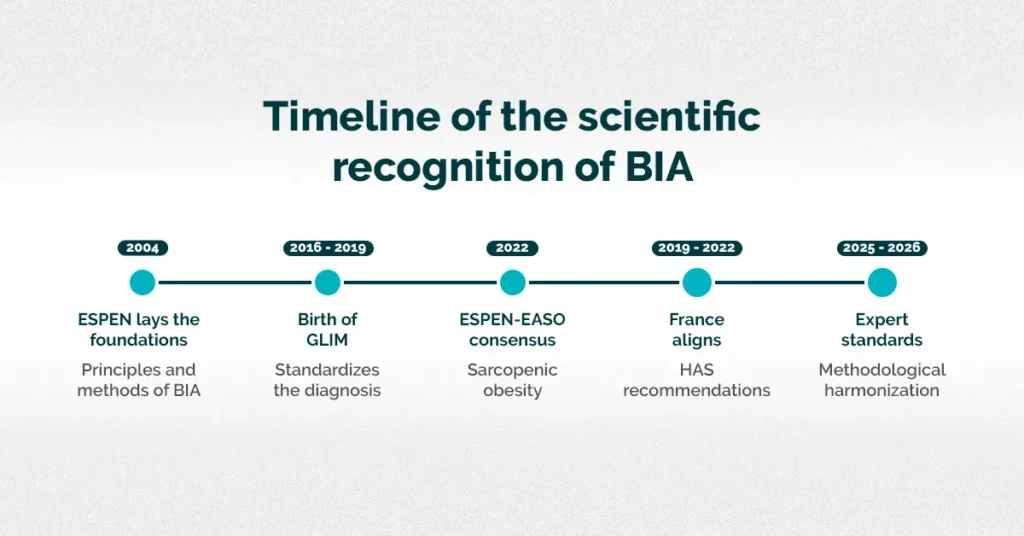
2004: ESPEN lays the methodological foundations of bioelectrical impedance analysis
Between 2002 and 2004, ESPEN (European Society for Clinical Nutrition and Metabolism) brought together an international working group of BIA experts—including Kyle, Deurenberg, Elia, Scharfetter, and Pichard, authors of several reference equations and methods. The objective: to critically evaluate the available data to establish the physical foundations of the method, specify its performance, indications, limitations, and the conditions for standardized use.
This work resulted in two complementary publications in Clinical Nutrition in 2004: Bioelectrical impedance analysis — Part I: Review of Principles and Methods1 and Part II: Utilization in Clinical Practice2. These two texts remain foundational references for the standardization of BIA today.
2016-2019: GLIM harmonizes the diagnosis of malnutrition
BIA is now primarily integrated into the diagnostic algorithms for malnutrition and obesity. In 2016, four major international scientific societies—ESPEN, ASPEN, FELANPE (Latin America), and PENSA (Asia)—created the Global Leadership Initiative on Malnutrition (GLIM) to harmonize the diagnosis of malnutrition in adults worldwide.
Published in 2019, the GLIM criteria3 standardized this diagnosis and recognized BIA as a method for assessing muscle mass, via two indicators: the Fat-Free Mass Index (FFMI) and the Appendicular Skeletal Muscle Index (ASMI), for which cutoff values were proposed. The 20224 and 20255 updates, published in Clinical Nutrition and JPEN, have maintained BIA among the usable methods for this criterion.
Figure — The major milestones in the recognition of BIA in clinical practice guidelines, from 2004 to 2026.
2015-2017: ESPEN broadens the scope of application
In 2015, within the framework of malnutrition diagnosis, ESPEN mentions the FFMI6. In 2017, its publication on definitions and terminology in clinical nutrition7 recommends BIA for the assessment of malnutrition, sarcopenia, and sarcopenic obesity, as well as for patient monitoring during treatment—with an agreement rate of 97% among the consulted experts, one of the highest in this body of recommendations. The same year, ESPEN formulated specific recommendations for an objective assessment of muscle mass in cancer patients8.
2019-2022: From caution to recognition for ASPEN and sarcopenic obesity
ASPEN’s position has progressively refined. Following the 2019 reservation mentioned above, the evolution of available data led to a more favorable stance on BIA: the 2022 GLIM guidelines4 explicitly recognize it as a method for assessing skeletal muscle mass, provided the interpretation is adapted to the clinical context.
Also in 2022, ESPEN and the European Association for the Study of Obesity (EASO) established a consensus on the diagnosis of sarcopenic obesity—the coexistence of excess adiposity and decreased muscle mass and function—integrating fat mass (%FM) and skeletal muscle mass adjusted for weight (SMM/W), both of which can be assessed by BIA9.
Specific applications by pathology
Nutritional assessment by BIA has also been studied in specific pathological contexts:
- COPD: the ERS (European Respiratory Society) recommended in 2014 the FFMI, SMMI, ASMI, and fat mass (FM) for nutritional and prognostic assessment11.
- Cystic fibrosis and HIV: the AND (Academy of Nutrition and Dietetics) guidelines include BIA among the assessment methods12,13.
- Intensive care: a Chinese guideline14 recommends BIA for nutritional risk screening and muscle mass monitoring in critical care, while a Korean single-center study15 explores the utility of the phase angle and the ECW/TBW ratio for prognosis in intensive care.
2025-2026: A methodological reset by a collective of experts
The series of publications initiated in 2025 by Prado, Heymsfield, Gonzalez, and Norman16,17, bringing together nearly 30 international body composition experts, addresses a recurring problem: the terminological and methodological confusion surrounding body composition assessment. It returns to the foundations of the discipline—levels of body organization, harmonized terminology—and details, for each method (bioimpedance, DXA, CT, ultrasound), its principles, validity, reliability, and limitations. It notably distinguishes clearly between BIA (SF/MF) and BIS, and recalls the limitations related to proprietary algorithms mentioned earlier.
The place of BIA in French recommendations
In France, the HAS (Haute Autorité de Santé), in collaboration with the French Federation of Nutrition (FFN), has published several good practice guidelines integrating BIA: for malnutrition in people aged 70 and over in 202118, for adults under 70 in 201919, and for adult obesity in 202220. The parameters FM%, SMM/W, FFMI, and ASMI are explicitly included.
In summary
The integration of BIA into the recommendations of scientific societies and health authorities has been built progressively, over twenty years, with assumed stages of caution (ASPEN 2019) as well as strong consensus (ESPEN 2017, 97% agreement). It is this trajectory—rather than the endorsement of a single society—that constitutes the strongest argument for a practitioner still wondering about the place of this tool in their practice.
To consult the details of the 22 cited recommendations, see the summary table of clinical practice guidelines.
References
- Kyle UG, Bosaeus I, De Lorenzo AD, et al. Bioelectrical impedance analysis—part I: review of principles and methods. Clin Nutr. 2004 Oct;23(5):1226-43.
- Kyle UG, Bosaeus I, De Lorenzo AD, et al. Bioelectrical impedance analysis-part II: utilization in clinical practice. Clin Nutr. 2004 Dec;23(6):1430-53.
- Cederholm T, Jensen GL, Correia MITD, et al. GLIM criteria for the diagnosis of malnutrition – A consensus report from the global clinical nutrition community. Clin Nutr. 2019 Feb;38(1):1-9.
- Compher C, Cederholm T, Correia MITD, et al. Guidance for assessment of the muscle mass phenotypic criterion for the Global Leadership Initiative on Malnutrition diagnosis of malnutrition. JPEN J Parenter Enteral Nutr. 2022 Aug;46(6):1232-1242.
- Jensen GL, Cederholm T, Correia MITD, et al. GLIM consensus approach to diagnosis of malnutrition: A 5-year update. JPEN J Parenter Enteral Nutr. 2025 May;49(4):414-427.
- Cederholm T, Bosaeus I, Barazzoni R, et al. Diagnostic criteria for malnutrition – An ESPEN Consensus Statement. Clin Nutr. 2015 Jun;34(3):335-40.
- Cederholm T, Barazzoni R, Austin P, et al. ESPEN guidelines on definitions and terminology of clinical nutrition. Clin Nutr. 2017 Feb;36(1):49-64.
- Arends J, Bachmann P, Baracos V, et al. ESPEN guidelines on nutrition in cancer patients. Clin Nutr. 2017 Feb;36(1):11-48.
- Donini LM, Busetto L, Bischoff SC, et al. Definition and Diagnostic Criteria for Sarcopenic Obesity: ESPEN and EASO Consensus Statement. Obes Facts. 2022;15(3):321-335.
- Sheean P, Gonzalez MC, Prado CM, McKeever L, Hall AM, Braunschweig CA. American Society for Parenteral and Enteral Nutrition Clinical Guidelines: The Validity of Body Composition Assessment in Clinical Populations. JPEN J Parenter Enteral Nutr. 2020 Jan;44(1):12-43.
- Schols AM, Ferreira IM, Franssen FM, et al. Nutritional assessment and therapy in COPD: a European Respiratory Society statement. Eur Respir J. 2014 Dec;44(6):1504-20.
- McDonald CM, Alvarez JA, Bailey J, et al. Academy of Nutrition and Dietetics: 2020 Cystic Fibrosis Evidence Analysis Center Evidence-Based Nutrition Practice Guideline. J Acad Nutr Diet. 2021 Aug;121(8):1591-1636.
- Willig A, Wright L, Galvin TA. Practice Paper of the Academy of Nutrition and Dietetics: Nutrition Intervention and Human Immunodeficiency Virus Infection. J Acad Nutr Diet. 2018 Mar;118(3):486-498.
- Guan X, Chen D, Xu Y. Clinical practice guidelines for nutritional assessment and monitoring of adult ICU patients in China. J Intensive Med. 2024 Feb 2;4(2):137-159.
- Lee Y, Kwon O, Shin CS, Lee SM. Use of bioelectrical impedance analysis for the assessment of nutritional status in critically ill patients. Clin Nutr Res. 2015 Jan;4(1):32-40.
- Prado CM, Gonzalez MC, Norman K, et al. Methodological standards for body composition-an expert-endorsed guide for research and clinical applications: levels, models, and terminology. Am J Clin Nutr. 2025 Aug;122(2):384-391.
- Prado CM, Gonzalez MC, Norman K, et al. Methodological standards for body composition assessment-an expert-endorsed guide for research and clinical applications: bioimpedance, DXA, CT, and ultrasound methods. Am J Clin Nutr. 2026 May;123(5):101283.
- Haute Autorité de Santé. Diagnostic de la dénutrition chez la personne de 70 ans et plus. Saint-Denis La Plaine: HAS; 2021.
- Haute Autorité de Santé. Diagnostic de la dénutrition de l’enfant et de l’adulte. Saint-Denis La Plaine: HAS; 2019.
- Haute Autorité de Santé. Obésité de l’adulte : prise en charge de 2e et 3e niveaux. Saint-Denis La Plaine: HAS; 2022.