BODY COMPARTMENTS
The different body composition analysis models
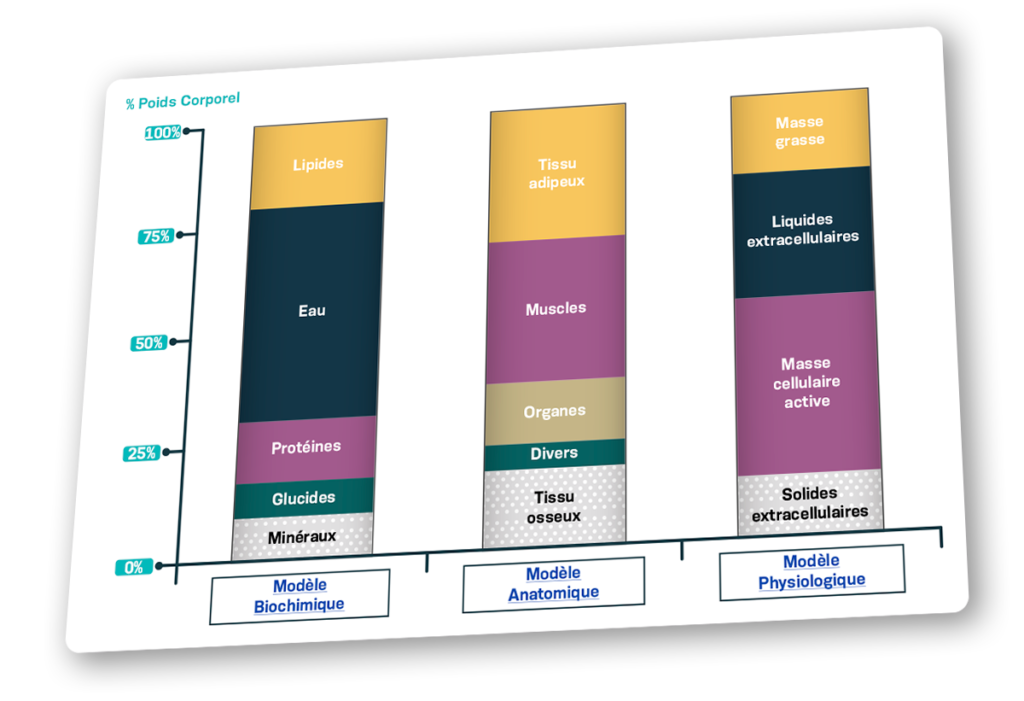
Biochemistry
Direct measurement performed on cadavers and serving as a reference for other techniques.
Anatomy
Indirect measurement used in medical imaging.
Physiology
Indirect measurement used in bio-impedance.
Reminder of the measurement principles with Biody XpertZM / Biody CoachZM / Biody LifeZM
The resistance of tissues to the passage of current varies according to the type of tissue and the frequency used; this is what allows for the determination of body compartments.
« Poor reproducibility has been observed at frequencies below 5 kHz and above 200 kHz »
- Frequencies between 50 and 500 kHz allow for the measurement of total water. Beyond 200 kHz, there is a slight loss of precision in repeatability, which is why multi-frequency devices generally use frequencies between 5 and 250 kHz.
- Frequencies between 1 and 7 kHz allow for the measurement of extracellular water because at these frequencies, the current does not pass through the cell membrane barrier. It is also important to know that the current passes through the skin barrier with more difficulty below 5 kHz, which is why the majority of multi-frequency devices have a frequency range between 5 and 250 kHz.
International Journal of Clinical Nutrition, 2014, Vol. 2, No. 1, 1-10 Available online at http://pubs.sciepub.com/ijcn/2/1/1 © Science and EducationPublishing DOI:10.12691/ijcn-2-1-1 : Poor reproducibility has been observed at frequencies below 5 kHz and above 200 kHz, especially for reactanceat low frequencies ( Hannan WJ, Cowen SJ, Fearson KCH, Plester CE, Falconer JS, Richardson RA. Evaluation of multi-frequency bioimpedanceanalysis for the assessment of extracellular and total body water in surgical patients. Clin Sci 1994; 86: 479-85. )
Our devices use the following frequencies: 5 / 20 / 50 / 100 / 200 kHz, which is the frequency range that provides the best results.
Physiological Models used in Bio-impedance
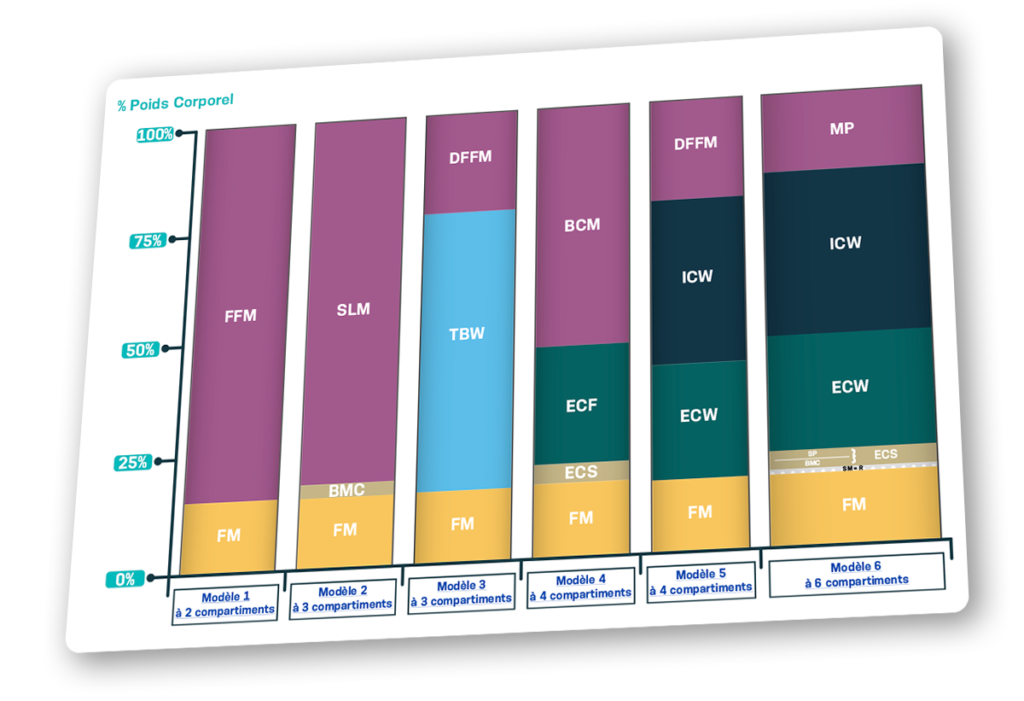
The models that allow the body to be broken down into more or less detailed compartments are described below.
The addition of these compartments in each model represents the total weight of the measured individual.